Introduction
Employee ownership can be an attractive part of a compensation package, but not every employee stock program works the same way. Two terms that often cause confusion are Employee Stock Ownership Plans (ESOPs) and Employee Stock Purchase Plans (ESPPs).
Both plans give employees a financial connection to their employer’s stock. However, the way employees receive shares, pay for them, access their money, and handle taxes is very different.
In the United States, an ESOP is generally a qualified retirement plan funded primarily with employer stock, while an ESPP is an employer-sponsored program that allows eligible employees to purchase company shares, often at a discounted price.
This distinction is important for employees comparing benefits, employers designing compensation programs, and business owners considering employee ownership.
In this guide, we compare ESOP vs ESPP, explain how each plan works under US rules, provide practical examples, and cover tax considerations that employees should understand before participating.
What Is an ESOP (Employee Stock Ownership Plan)?
An Employee Stock Ownership Plan is a type of qualified defined contribution retirement plan established under Section 401(a) of the Internal Revenue Code. It is designed to invest primarily in the employer’s stock.
Unlike a traditional stock purchase program, employees generally do not use their own salary deductions to buy shares in a standard ESOP. Instead, the employer contributes company stock or cash used to acquire company shares for the plan.
The shares are held in an ESOP trust and allocated to eligible employees’ individual plan accounts according to the plan’s allocation formula.
How Does an ESOP Work?
A typical ESOP operates through the following steps:
- The employer establishes the plan: The company creates an ESOP under applicable federal retirement plan rules.
- A trust holds company shares: The ESOP trust receives employer stock or acquires shares using employer contributions or financing.
- Shares are allocated: Eligible employees receive allocations to their individual ESOP accounts under the plan’s formula.
- Employees earn vested benefits: Employees become entitled to their account benefits according to the plan’s vesting schedule and federal requirements.
- Benefits are distributed: When employees retire or leave the company, distributions are made according to the plan and applicable law.
ESOPs are regulated by the IRS and the Department of Labor. They must satisfy applicable tax qualification requirements and fiduciary responsibilities.
For the official definition, see the IRS Employee Stock Ownership Plans guidance.
What Is an ESPP (Employee Stock Purchase Plan)?
An Employee Stock Purchase Plan allows eligible employees to buy company shares, commonly through payroll deductions. Many employers offer shares at a discount to the market price.
Unlike an ESOP, an ESPP generally requires employees to contribute their own money to purchase shares.
A typical ESPP uses an offering period during which employees authorize payroll deductions. At the end of the offering period, the accumulated contributions are used to purchase company stock according to the plan’s terms.
Some plans offer a feature called a lookback provision. It may calculate the purchase price using the lower stock price on the offering date or purchase date, followed by an additional discount.
How Does an ESPP Work?
A common ESPP process looks like this:
- Enrollment: Eligible employees sign up during an enrollment window.
- Payroll deductions: A selected percentage or amount of eligible compensation is deducted from paychecks.
- Offering period: The money accumulates during the plan’s offering period.
- Share purchase: The accumulated funds purchase shares at the plan’s specified price.
- Holding or selling: Employees can generally hold or sell the purchased shares, subject to trading restrictions and applicable tax rules.
Not every ESPP offers the same discount, purchase schedule, or lookback feature.
Qualified vs. Nonqualified ESPPs
A particularly important distinction for US employees is that not every ESPP qualifies for special tax treatment under Section 423.
A qualified Section 423 ESPP must meet specific requirements under the Internal Revenue Code. These include rules concerning shareholder approval, employee eligibility, ownership restrictions, and the plan’s purchase options.
A nonqualified ESPP does not meet all the Section 423 requirements. Its tax treatment can differ, so employees should not assume that every payroll-based stock purchase plan receives the same tax advantages.
The governing federal law is Internal Revenue Code Section 423.
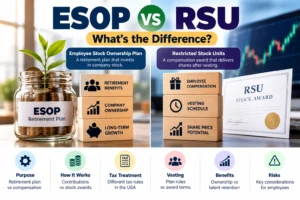
ESOP vs ESPP: Key Differences
Although both programs involve employer stock, their structures and purposes are different.
| Comparison | ESOP | ESPP |
| Full form | Employee Stock Ownership Plan | Employee Stock Purchase Plan |
| Main purpose | Retirement benefit and employee ownership | Employee stock purchasing |
| Who funds it? | Generally the employer | Generally the employee |
| How shares are acquired | Employer contributes shares or funds their purchase | Employee purchases shares through payroll deductions or other permitted contributions |
| Employee purchase price | Employees generally do not purchase allocated shares | Employees pay the plan’s purchase price |
| Account structure | Shares or other plan assets are held in an ESOP trust | Purchased shares are generally held in the employee’s brokerage or stock plan account |
| Vesting | Benefits may vest over time | Purchased shares are generally owned after purchase, subject to plan and securities restrictions |
| Access to money | Generally governed by retirement plan distribution rules | Employees may generally sell shares, subject to restrictions |
| Tax framework | Qualified retirement plan rules | Section 423 rules for qualifying ESPPs; different rules for nonqualified plans |
| Common business purpose | Retirement benefits and ownership transition | Employee participation in company stock performance |
The key distinction is simple: an ESOP is primarily a retirement benefit plan, while an ESPP is primarily a stock purchasing program.
Real-World Examples: How ESOP and ESPP Work
Examples make the difference easier to understand.
Example 1: Employee Participating in an ESOP
Suppose a US manufacturing company establishes an ESOP and contributes company shares for eligible employees.
An employee receives an annual allocation of shares worth $4,000. The employee does not pay $4,000 from their paycheck to receive that allocation.
Over several years, additional shares are allocated to the employee’s account. The employee’s vested benefit grows or declines depending on the number of shares, the company’s stock value, and the plan’s terms.
When the employee retires or leaves the company, the ESOP generally distributes the vested benefit according to the plan and applicable distribution rules.
This example illustrates how an ESOP can build retirement wealth without requiring employees to purchase their allocated shares.
Example 2: Employee Participating in an ESPP
Suppose a technology company offers an ESPP with a 15% discount and no lookback provision.
An employee contributes $200 per month for six months.
- Monthly contribution: $200
- Offering period: 6 months
- Total contributions: $1,200
- Stock price at purchase: $40
- ESPP discount: 15%
- Purchase price: $34 per share
The employee can purchase:
$1,200 ÷ $34 = approximately 35.29 shares, subject to the plan’s whole-share and fractional-share rules.
The employee has used personal payroll deductions to purchase company stock at a discount.
Unlike an ESOP allocation, the employee has paid for these shares using their own earnings.
Tax Differences Between ESOP and ESPP in the United States
Tax treatment is one of the most important differences between these programs. Employees should understand when income may be recognized and what happens when shares are sold or distributed.
How Are ESOPs Taxed?
In a typical qualified ESOP, employer contributions and investment earnings are generally not included in an employee’s current taxable income merely because shares are allocated to their account.
Tax is generally deferred until the employee receives a taxable distribution, subject to applicable rules.
When an employee receives an ESOP distribution, the amount is generally treated as ordinary income unless a specific tax rule or election applies. Eligible distributions may be rolled over to an IRA or another eligible retirement plan, potentially postponing current taxation.
Additional rules may apply to lump-sum distributions, employer securities, and net unrealized appreciation (NUA). Early distributions may also trigger an additional tax unless an exception applies.
Employees should review IRS Publication 575: Pension and Annuity Income and consult a tax professional before taking a distribution.
How Are ESPPs Taxed?
The tax treatment of an ESPP depends on whether it is a qualifying Section 423 plan and when the employee sells the purchased shares.
For a qualifying Section 423 ESPP, employees generally do not recognize income when the option is granted or exercised. Tax consequences usually arise when the shares are sold or otherwise disposed of.
Two types of dispositions are important:
1. Qualifying disposition
To receive the special Section 423 treatment, the employee must generally hold the shares until the later of:
- Two years after the option grant date.
- One year after the shares were transferred to the employee.
If these holding periods are met, part of the gain may be treated as ordinary compensation income, while any additional gain is generally capital gain.
2. Disqualifying disposition
If the employee sells the shares before satisfying both holding periods, the sale is generally a disqualifying disposition.
The discount-related compensation amount is generally included in ordinary income under the applicable rules, with any remaining gain or loss treated under the capital gain and loss rules.
The exact calculation depends on the plan’s purchase price, grant-date value, purchase-date value, and sale price.
For more detail, read IRS Publication 525: Taxable and Nontaxable Income and the IRS guidance on Section 423 ESPP reporting.
Benefits of an ESOP
ESOPs can provide long-term financial and business benefits for employees and employers.
1. Retirement wealth building
Employees can accumulate company shares without purchasing them directly. Over time, allocations and changes in company value can increase the value of their retirement accounts.
2. No direct employee purchase cost
In a typical ESOP, the employer funds the plan. Employees do not generally need to contribute their own money to receive allocated shares.
3. Employee ownership culture
Employees may feel more connected to the company’s performance when they have a financial interest in its success.
4. Business succession planning
An ESOP can provide business owners with a way to sell part or all of their company to an employee ownership trust. This can create a succession option for privately held businesses.
5. Potential tax advantages
Qualified ESOPs can provide tax advantages to employers and employees when they meet the applicable requirements. Certain qualifying transactions may also allow selling shareholders to defer capital gains under Section 1042, subject to strict conditions.
Benefits of an ESPP
An ESPP offers a different set of benefits, particularly for employees who want to invest in their employer’s publicly traded stock.
1. Discounted share purchases
Many employers offer shares below market value. A 15% discount, for example, allows employees to purchase shares for $85 when the applicable market price is $100, assuming the plan uses that pricing method.
2. Convenient payroll deductions
Employees can invest gradually through automatic paycheck deductions instead of arranging a separate investment every month.
3. Potential stock appreciation
If the company’s share price increases after purchase, employees may benefit from the difference between their purchase price and the market value.
4. Flexible investment decisions
After purchasing shares, employees can generally choose when to sell, subject to company trading policies, securities laws, and any applicable holding-period considerations.
5. Potential favorable tax treatment
A qualifying Section 423 ESPP can offer special tax treatment when employees meet the required holding periods. However, a qualifying disposition does not mean the entire gain is automatically tax-free or taxed as long-term capital gain.
Risks and Disadvantages of ESOPs and ESPPs
Both programs can create financial opportunities, but employees should understand the risks before treating company stock as a guaranteed benefit.
ESOP risks
- Company concentration: A large portion of retirement savings may depend on one company’s performance.
- Limited diversification: ESOPs are designed primarily to invest in employer stock, although federal rules provide diversification rights to certain participants.
- Distribution restrictions: Employees may not be able to access their vested benefits immediately when they want to.
- Stock valuation risk: The value of privately held company shares can change and may not be easy to convert into cash.
- Company performance: A decline in the employer’s value can reduce the value of the ESOP account.
Federal law provides diversification rights for certain ESOP participants who meet age and service requirements. Generally, eligible participants who have attained age 55 and completed at least 10 years of participation must be given an opportunity to diversify a portion of their accounts. The exact requirements and available elections should be reviewed in the plan documents.
The Department of Labor’s ESOP resources explain participant rights and important plan information.
ESPP risks
- Stock price volatility: Shares can decline after purchase, potentially creating a loss.
- Concentration risk: Employees may already depend on the employer for salary, so investing additional savings in the same company increases financial exposure.
- Payroll commitment: Contributions reduce take-home pay during the offering period.
- Tax complexity: Selling too early may create a disqualifying disposition and different tax consequences.
- Trading restrictions: Company blackout periods and insider-trading policies may limit when employees can sell shares.
A discounted purchase price does not eliminate investment risk. Employees should consider their financial situation before committing a large portion of their salary to company stock.
What Happens When an Employee Leaves the Company?
Leaving an employer can affect ESOP and ESPP participation differently.
Leaving a company with an ESOP
An employee who leaves generally retains the vested portion of their ESOP benefit, subject to the plan’s terms and applicable federal law.
The timing of distributions can depend on the reason for leaving, the plan’s provisions, and statutory requirements. Some distributions may be delayed, and employees may have the option to roll eligible amounts into an IRA or another qualified retirement plan.
Employees should request their Summary Plan Description (SPD) and ask the plan administrator:
- What percentage of the account is vested?
- When will distributions begin?
- Can the benefit be rolled over?
- Will the distribution be made in cash or company stock?
- Are any distribution restrictions applicable?
Leaving a company with an ESPP
An employee leaving a company may have payroll deductions refunded if the shares have not yet been purchased, depending on the plan’s terms.
If shares have already been purchased, the employee generally continues to own them, subject to applicable restrictions. The employee should review the plan’s termination provisions and brokerage account records.
Leaving employment does not automatically remove the tax consequences of a later stock sale.
Important Tax Documents Employees Should Know
Understanding the relevant documents can prevent mistakes when preparing a US tax return.
| Document | Why it matters |
| Form 1099-B | Reports proceeds from the sale of shares through a broker. |
| Form 3922 | Helps track grant-date and purchase-date information for certain Section 423 ESPP shares. |
| Form W-2 | May report compensation income resulting from an ESPP disposition. |
| Form 1040 | Used to report individual federal income tax information. |
| Form 8949 | Reports sales and other dispositions of capital assets. |
| Schedule D | Summarizes capital gains and losses. |
| ESOP Summary Plan Description | Explains eligibility, vesting, allocations, distributions, and participant rights. |
A common ESPP mistake is reporting the full sale proceeds as a capital gain without adjusting the cost basis for compensation income already included in wages.
The IRS provides details about Form 3922 in its official Form 3922 guidance.
Which Is Better: ESOP or ESPP?
There is no universal winner. The better program depends on the employee’s financial goals and how the employer structures the benefit.
| Employee goal | Program that may be more relevant |
| Build retirement benefits without purchasing shares | ESOP |
| Buy employer shares through payroll deductions | ESPP |
| Receive employer-funded stock allocations | ESOP |
| Purchase shares at a potential discount | ESPP |
| Participate in a company’s ownership transition | ESOP |
| Invest in publicly traded employer stock | ESPP |
| Receive retirement-plan distribution benefits | ESOP |
An ESOP may be attractive to employees seeking an employer-funded retirement benefit. An ESPP may appeal to employees who want to invest their own money in company shares, particularly when a meaningful discount is available.
Employees should compare the actual plan terms rather than choosing based only on the program’s name.
Common Terminology Confusion: ESOP vs Employee Stock Option Plan
One of the biggest sources of confusion in US equity compensation is the abbreviation ESOP.
In the United States, ESOP normally means Employee Stock Ownership Plan, a qualified retirement plan.
Some companies and international websites use ESOP to mean Employee Stock Option Plan. However, that is not the standard US retirement-plan meaning.
An employee stock option gives an employee the right to purchase company shares at a specified exercise price, subject to the option agreement. It is different from both an ESOP and an ESPP.
The SEC’s Investor.gov ESOP explanation specifically warns readers not to confuse employee stock ownership plans with employee stock option plans.
If your employer says it offers an ESOP, ask whether it means a qualified retirement plan, an employee stock option arrangement, or another equity compensation program. This clarification can make a significant difference to your financial and tax planning.
Frequently Asked Questions
1. Is an ESOP the same as an ESPP?
No. An ESOP is generally a qualified retirement plan funded primarily with employer stock. An ESPP allows eligible employees to purchase company shares, often through payroll deductions and at a discount.
2. Do employees pay for ESOP shares?
Generally, employees do not directly purchase shares allocated to their accounts in a standard ESOP. The employer funds the plan through contributions or other permitted arrangements.
3. Can an ESPP offer a 15% discount?
Yes. Many ESPPs offer a discount of up to 15%, although the actual discount and purchase-price formula depend on the employer’s plan. Section 423 has specific statutory requirements for qualifying plans.
4. Are ESOP distributions taxable?
Generally, distributions from a qualified ESOP are taxable when received unless an applicable rollover or other tax rule applies. Early distributions may also trigger additional tax.
5. Are ESPP shares taxed when purchased?
For a qualifying Section 423 ESPP, employees generally do not recognize income when the option is granted or exercised. Tax consequences usually arise when the shares are sold or otherwise disposed of.
6. What is a qualifying ESPP disposition?
A qualifying disposition generally occurs when shares are sold after both required holding periods are met: more than two years after the option grant date and more than one year after the shares are transferred to the employee.
7. Can an employee participate in both an ESOP and an ESPP?
Yes, if the employer offers both programs and the employee meets their eligibility requirements. They serve different purposes and can operate alongside each other.
8. Is an ESOP better than a 401(k)?
Not necessarily. An ESOP primarily invests in employer stock, while a traditional 401(k) may offer a wider selection of investment options. Some companies offer both. Employees should consider diversification, fees, investment choices, and retirement needs.
Conclusion
Understanding ESOP vs ESPP is important for anyone evaluating employee stock benefits in the United States. Although both programs connect employees to company ownership, they operate under different structures and tax rules.
An ESOP is generally an employer-funded, qualified retirement plan that allocates company shares to employee accounts. An ESPP allows employees to purchase company shares, often at a discounted price through payroll deductions.
The right choice depends on whether your priority is building retirement benefits through employer contributions or purchasing shares as an investment. Before enrolling, review the plan documents, understand the tax implications, and consider the risks of holding too much company stock.
For more help understanding employee stock benefits and retirement planning, explore the CalcZest ESOP Calculator.
Disclaimer: This article is for educational purposes only and does not constitute tax, legal, investment, or retirement advice. ESOP and ESPP rules depend on the plan documents and applicable federal and state laws. Consult a qualified tax professional or retirement plan adviser for guidance on your circumstances.